EpicPWA Review: A Ready-Made Ecosystem for Creating and Managing PWA Applications
Progressive web applications have become a practical alternative to classic mobile applications for teams that need flexible distribution, fast testing and direct control over product logic. This review looks at EpicPWA, a platform designed to create and manage PWAs from one interface.
Google Play and the App Store can add friction to mobile distribution through reviews, account-history requirements, geographic restrictions and policy-related interruptions. PWAs offer a browser-based route that can be launched outside traditional app stores while keeping the product, domain and traffic logic under the operator's control.
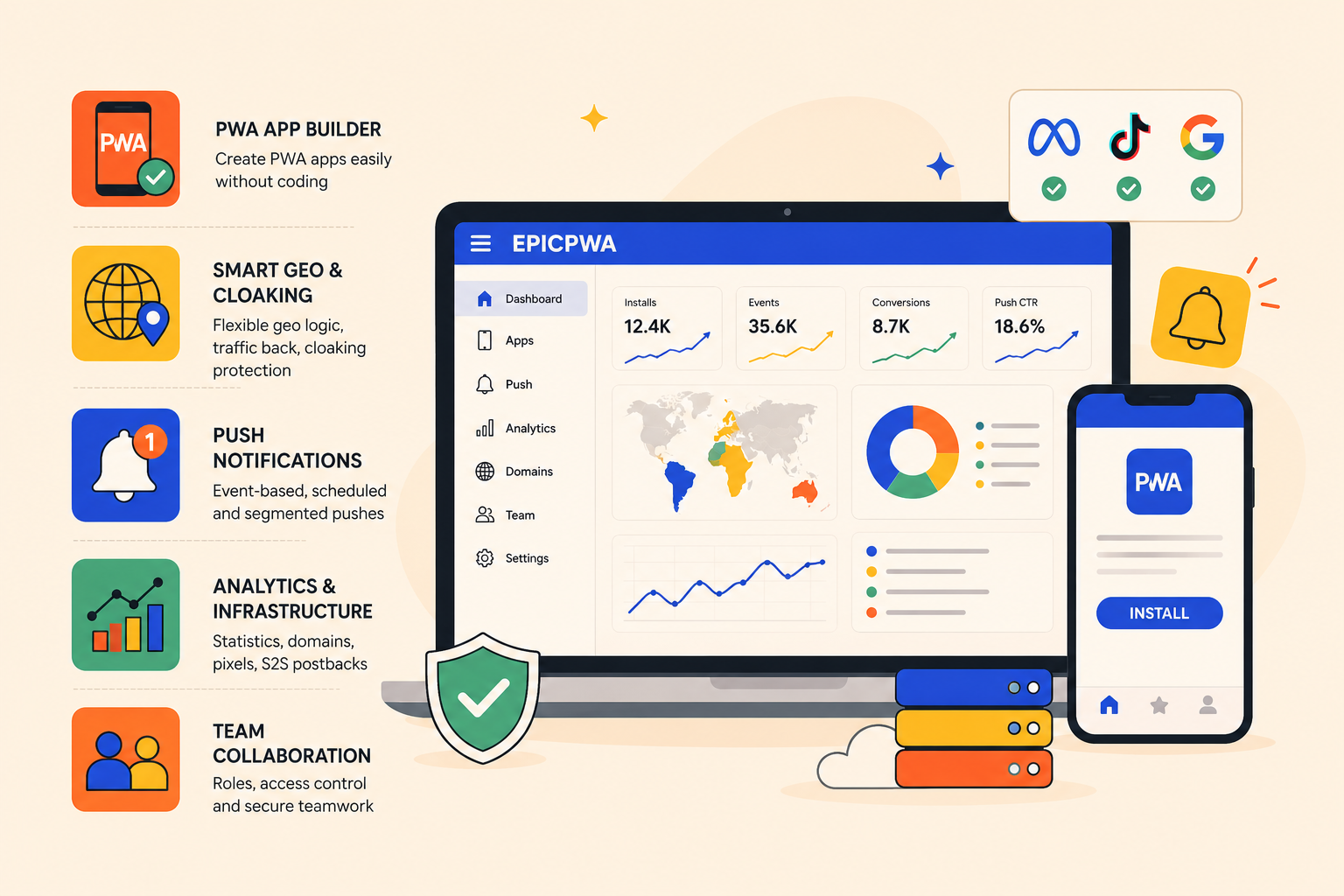
EpicPWA is positioned as a platform for creating and managing PWA applications, initially oriented toward traffic-arbitrage workflows in the gambling and betting verticals. Its feature set covers the PWA workflow from app creation and domain binding to push notifications, geo rules, traffic routing and analytics.
What Is EpicPWA and What Is Its Core Value?
EpicPWA is more than a basic PWA builder. It is intended for individual arbitrage specialists and media-buying teams that need to launch bundles quickly, test hypotheses and manage applications without assembling infrastructure from several unrelated services.
The central idea is to bring core functions into one interface. Users can manage applications, domains, push notifications and analytics from a unified workspace. The platform also offers a free tier that allows up to three PWA applications, giving new users an opportunity to test the workflow before committing to a paid plan. Check the current terms directly on the provider's website because pricing and limits may change.
How EpicPWA Looks from the Inside
After registration and login, the user enters the EpicPWA dashboard. The dashboard is designed to show key metrics for projects, including installs, user events, conversions and push-notification performance.
The main sections are available in a side navigation menu, so users can move between applications, push campaigns, analytics, domains and settings without repeatedly switching between separate services. This structure is useful for teams that manage several projects or test multiple traffic scenarios at once.
Creating a PWA Application: Key Settings
Creating an application does not require conventional programming skills. The process is divided into clear stages, beginning with the basic application configuration and continuing through design, traffic rules and measurement.
In the Create PWA area, users can configure application details, visual settings, geo-targeting, cloaking options and analytics. A preview function makes it possible to check the appearance of an application before launch.
Basic Application Parameters
The initial settings include the application name, category, domain selection and user code. The application and comments sections can be used to configure the visible presentation and supporting information. Ready-made templates can also speed up the initial launch and reduce avoidable setup errors.
When preparing pre-landing pages or visual showcases, professional and realistic design examples can improve clarity and user confidence. Editable design resources, including PSD templates and editable PSD files, invoice or document mockup templates, may help content creators prepare comparison pages, visual guides and other supporting materials. Any such resources should be used lawfully and should not be presented as official documents.
Smart Geo Logic and Cloaking
The tracking and geo section provides rules for directing traffic according to region and user conditions. The available workflow may include:
- setting a traffic-back URL for non-target traffic;
- configuring a back-button URL to reduce accidental exits;
- adjusting geographic and display conditions for different regions; and
- organizing different funnel scenarios within one control panel.
This type of routing is particularly relevant to campaigns that operate across multiple geographies. Cloaking functions, where available, should be used only in accordance with advertising-platform rules, applicable law and the terms of the traffic source. They should never be used to conceal unlawful content or mislead reviewers and users.
Built-In Push Notification System
Push notifications in EpicPWA are presented as a retention and reactivation channel rather than only a bulk-messaging feature. Depending on the configuration, users can:
- trigger notifications after defined events;
- schedule messages;
- segment users according to behaviour or status; and
- control frequency and delivery scenarios.
Used responsibly, this makes push notifications part of the broader customer journey. Operators should obtain the appropriate consent, provide an easy opt-out and follow privacy, electronic-communications and platform requirements in every relevant jurisdiction.
Infrastructure and Analytics
One of the platform's main benefits is the combination of launch infrastructure and measurement tools. A central dashboard can make it easier to understand the path from installation to key events and to identify where users leave a funnel.
Internal Statistics
EpicPWA's reported metrics include installs, events, conversions, application opens, interface interactions and push click-throughs. Reviewing these signals can help operators compare scenarios and focus optimization on observed behaviour rather than assumptions.
Domain Management
Centralized domain management can simplify bundle relaunches, domain changes and work across multiple geographies. It may also reduce the amount of repetitive manual setup required when several projects are active.
Pixel Integrations
Integrations with advertising pixels can transmit selected user actions to advertising dashboards. This can support retargeting and event-based campaign optimization, provided that tracking is disclosed and implemented with the required permissions.
S2S Postbacks
Server-to-server postbacks are designed to transfer conversion information between the platform, trackers and affiliate networks. Accurate attribution depends on correct implementation, stable identifiers and compliance with the policies of each connected service.
Team Collaboration
For media-buying teams, role and access management can help separate responsibilities, protect project settings and coordinate work across several applications. Permission design should follow the principle of least privilege so that each team member receives only the access necessary for their role.
Support and Future Development
The EpicPWA team presents the product as an actively maintained ecosystem for PWA traffic management. Support is available through the provider's communication channels, including Telegram, according to the supplied product information. Prospective users should verify response times, service availability and current documentation before relying on the platform for a critical campaign.
Final Verdict
EpicPWA brings together the main operational tasks involved in launching and managing PWA applications: application creation, domain configuration, traffic rules, push notifications, analytics and conversion tracking. Its unified approach may be useful for arbitrage specialists and media-buying teams that want to test and manage several PWA workflows from one dashboard.
The free tier, described as supporting up to three applications, provides a low-risk way to evaluate the interface and basic workflow. Because features, limits and policies can change, users should confirm the current terms directly before making a business decision.